White Alba Truffle 2026: A Season Forecast — and 30 Years of Abrate & Sons Bringing It to Hong Kong and Macau
Every autumn, a quiet event happens in the misty hills of Piedmont that ripples all the way to the dining tables of Hong Kong and Macau. Deep in the oak and poplar forests of the Langhe and Roero, a trained dog stops, noses at the earth, and a trifolao — a truffle hunter — kneels down with a small hoe. What emerges from the soil, if the season has been kind, is the most coveted ingredient in the culinary world: the White Alba Truffle, Tuber magnatum Pico.
As we look ahead to the 2026 season, we want to share what we know about the weather, the official opening dates, and what it might mean for quality and availability this year. We also want to mark something personal to us: 2026 is the 30th season that Abrate & Sons has imported White Truffle from Alba into Hong Kong and Macau, and we could not be prouder of the relationship we’ve built over three decades with our exclusive source, Tartuflanghe.
When Does the 2026 Season Officially Begin?
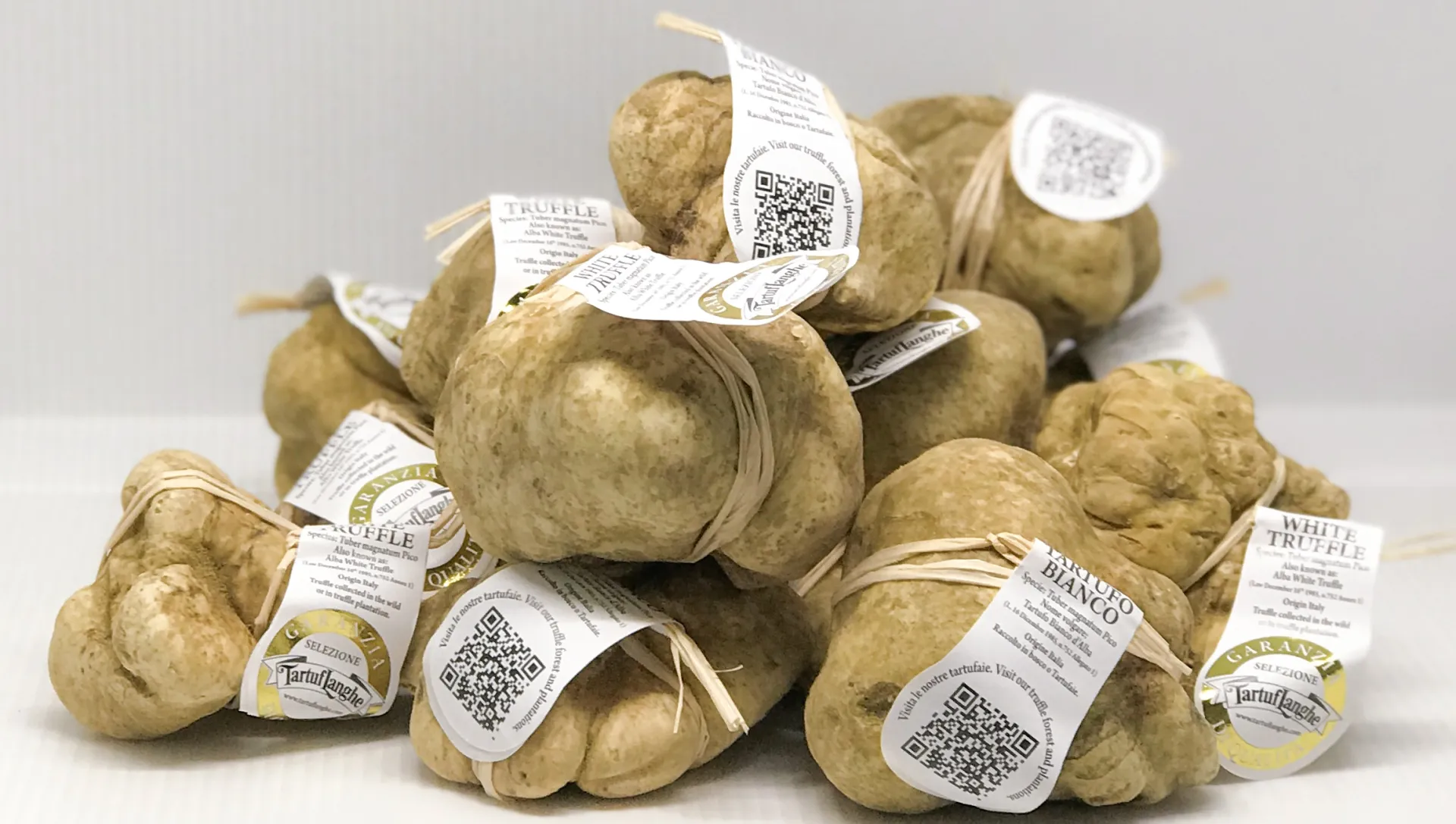
Unlike wine, which can be planted, tended, and harvested on a predictable calendar, the white truffle answers to no one but nature. It cannot be cultivated, farmed, or forced — it grows wild, in symbiosis with the root systems of specific trees, and only a trained nose can find it.
That said, the region does regulate when the truffle may be legally harvested and sold. For the 2026 season, barring any regional updates tied to climate conditions, the official collection period will begin on 1 October and run through 31 January 2027. This is consistent with the broader pattern for Tuber magnatum, where the season generally runs from 1 October to 31 January, with peak quality typically falling in October and November.
Interestingly, the opening date has shifted over the years. Climate change has had a meaningful impact on the natural cycle of Tuber Magnatum Pico in recent seasons, and prolonged, hot summers combined with periods of drought have pushed Piedmontese authorities to adopt protective measures for the harvest. As a result, the opening of the season has been pushed later than in the past, when it traditionally began in September. This is a small but telling signal of how seriously the region takes protecting the quality and the long-term sustainability of the truffle-bearing forests — a philosophy we share deeply at Abrate & Sons.
Alongside the official harvest window, the world will be watching Alba itself, where the historic Fiera Internazionale del Tartufo Bianco d’Alba — the International White Truffle Fair — celebrates its 96th edition in 2026. This year’s fair runs every Saturday and Sunday from 10 October through 6 December, with the Truffle Market open daily at the Cortile della Maddalena in the heart of Alba. For nearly a century, this fair has been the beating heart of the truffle trade, where producers, restaurateurs, buyers, and truffle lovers from around the world gather for tastings, auctions, cooking demonstrations, and cellar dinners.
If you’re planning your own trip to the source, seasoned visitors suggest timing it well: the second and third weekends of November are historically considered the best for truffle quality, fragrance, and overall festival programming, while the earlier October weekends tend to be quieter and easier to combine with winery visits.
What the Weather Is Telling Us
If you ask any trifolao what determines a great season, the answer is almost always the same: it’s all about the rain. The white truffle is entirely dependent on natural conditions — soil moisture, temperature, humidity, and the health of the surrounding forest — and no two years are ever quite alike.
The general rule, echoed across truffle experts in the Langhe, is straightforward but demanding: a year with good soil humidity and balanced temperatures tends to favor greater truffle availability and a more expressive aroma, whereas periods that are too dry, prolonged heat, or irregular rainfall can negatively affect both the quantity harvested and the quality of the product. This is precisely why, as truffle specialists note, it remains genuinely difficult to predict price and availability with precision before the official start of the harvest.
Rainfall timing matters just as much as rainfall volume. As one Piedmontese truffle authority puts it, rainfall in late summer has a direct influence on the year’s yield — too dry and the truffles remain small or scarce, too wet and quality itself can suffer. A “balanced” season, one with steady, well-distributed moisture rather than extremes in either direction, is what produces the dense, richly aromatic specimens that chefs and connoisseurs prize most highly.
Temperature plays its own critical role, particularly as the season transitions from summer to autumn. Locals in the Langhe often say the truffle reaches its finest character only once the first real cold weather arrives, which is why mid-November through December is typically considered the prime window for the strongest, most pungent aroma. Ideal early-October conditions for the truffle sit in a fairly narrow band — temperatures around 15 to 18 degrees Celsius alongside seasonally appropriate rainfall — quite different from the unusually hot, out-of-season spells of 26 to 31 degrees that the region has experienced in some recent years.
What all of this means for 2026 is that, as always, the true picture will only become clear once the harvest is underway. What we can say is that the fundamentals — moisture in the soil heading into autumn, and a proper cool-down as October progresses — are the two things every experienced hunter and every serious importer watches closely in the weeks before the first truffles reach the market. We’ll be following these conditions closely through October and will share updates on pricing, size, and aromatic intensity as the season develops.
Why Provenance Matters: Not All White Truffle Is Alba White Truffle
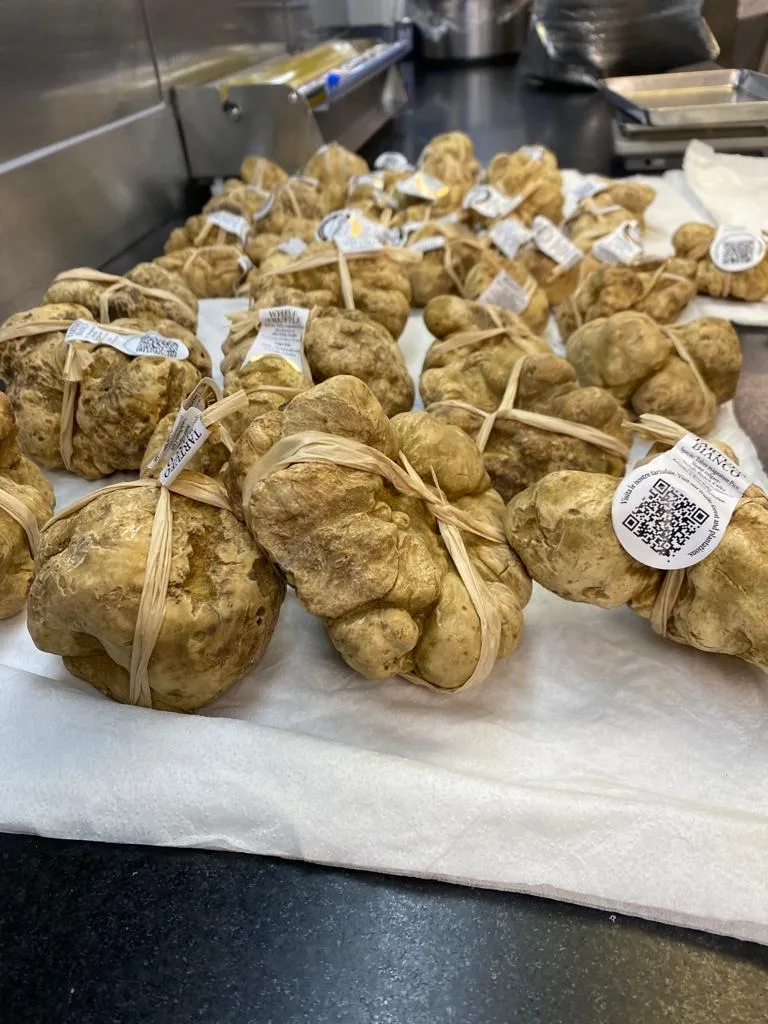 One of the most common misconceptions among newcomers to Tuber magnatum Pico is the assumption that “white truffle” is a single, uniform product wherever it’s found. It isn’t. While the species does grow beyond the Langhe and Roero — in other pockets of Italy such as the Marche region around Acqualagna, and even further afield in parts of the Balkans, including areas of Bosnia and Herzegovina — the truffle that emerges from the specific soil, microclimate, and forest ecology of the Alba area is widely regarded by chefs, buyers, and connoisseurs as being in a class of its own.
This is the essence of provenance, and it’s a concept every serious buyer of fine food or wine already understands intuitively. Just as a Nebbiolo grape expresses itself entirely differently depending on whether it’s grown in Barolo, Barbaresco, or a vineyard thousands of kilometers away, Tuber magnatum Pico is profoundly shaped by where it grows. The particular composition of the Langhe’s calcareous, clay-rich soils, the specific mix of oak, poplar, willow, and hazel root systems it partners with, and the region’s characteristic seasonal rainfall and fog patterns all combine to produce a truffle with a more complex, more intensely layered aroma than specimens of the same species harvested elsewhere.
This is precisely why “Alba” is not just a place name attached to a product for marketing purposes — it is a designation that carries real weight in the truffle trade, in much the same way that a wine region’s name signals a distinct character shaped by its terroir. A truffle labeled as coming from Alba should genuinely have grown in that territory, and buyers who care about authenticity should always ask where a truffle was actually hunted, not simply what species it belongs to.
For us, this is exactly why our exclusive relationship with Tartuflanghe matters so much. It isn’t enough to source genuine Tuber magnatum Pico — we insist on truffles hunted specifically within the Langhe and Roero territories that give the Alba name its meaning. When we tell our clients in Hong Kong and Macau that they are receiving Alba White Truffle, that claim is backed by a direct, verifiable chain back to the specific forests the region is famous for — not simply the correct species sourced from wherever it happened to be convenient to buy.
Thirty Seasons of Bringing Alba to Hong Kong and Macau
For most of the people reading this, the White Alba Truffle is not something abstract read about in a fair guide — it’s something that has, for thirty consecutive years, made its way onto our tables here in Hong Kong and Macau, carried across nearly 9,000 kilometers from a small corner of northern Italy.
2026 marks Abrate & Sons’ 30th season importing White Truffle from Alba into this region. Three decades ago, when fresh Italian white truffle in Hong Kong was a rarity known only to a handful of dedicated restaurants, we made a commitment: to build a direct, trustworthy line between the forests of the Langhe and the kitchens and homes of our city. Thirty years later, that commitment hasn’t changed, even as the market, the climate, and the truffle trade itself have all evolved considerably.
What has made three decades of continuity possible is not luck — it’s relationship. A product this unpredictable, this fleeting, and this valuable cannot be sourced casually or through shifting intermediaries. It requires a partner on the ground who understands the forests, the hunters, and the market as intimately as we understand our clients here in Asia.
Why Tartuflanghe, and Why Exclusivity Matters
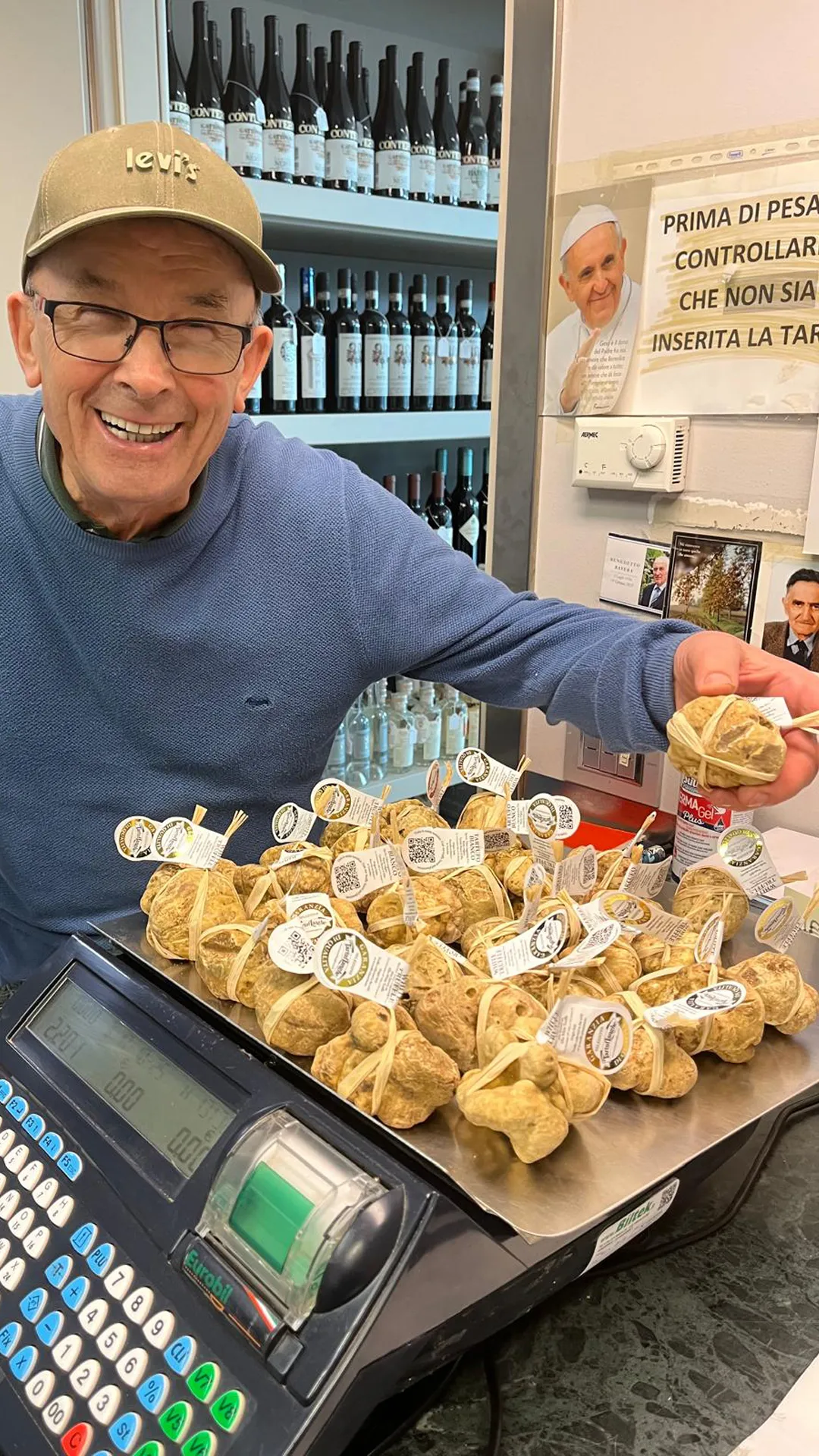 That partner, for us, has always been Tartuflanghe — our exclusive source for White Alba Truffle. Based in the Langhe itself, Tartuflanghe has spent decades cultivating relationships with the region’s most trusted trifolau, giving them privileged access to specimens hunted from the very forests that produce the finest examples of Tuber magnatum Pico.
Exclusivity is not simply a marketing term for us — it’s a quality mechanism. Because we work with a single, dedicated supplier rather than a rotating network of traders, every truffle that reaches Hong Kong and Macau through Abrate & Sons has passed through a consistent chain of expertise: hunters who know exactly where and when to look, graders who understand what separates an exceptional specimen from an ordinary one, and a logistics process built specifically around preserving a product with an extraordinarily short shelf life.
This matters enormously with white truffle, more than with almost any other gourmet ingredient. As anyone who has cooked with it knows, its famous aroma begins fading the moment it’s out of the ground. A truffle graded and shipped by someone who truly understands the product — its ideal firmness, its characteristic ochre-toned skin, its knobby but dense shape — arrives at its destination in a completely different state than one handled carelessly along the way. The white truffle undergoes a genuinely unique journey from forest to table, and every stage of that journey affects what finally reaches the plate.
Working exclusively with Tartuflanghe also means we can offer something increasingly rare in a market flooded with substitutes: certainty of species. As truffle specialists frequently caution, several other species are sold as “white truffle” when only Tuber magnatum genuinely qualifies — Tuber borchii, commonly called bianchetto, looks similar but carries a much thinner, garlicky aroma and belongs to an entirely different season, typically January through April. When you order from Abrate & Sons, you are getting the genuine Tuber magnatum Pico of Alba — verified at the source, not a seasonal look-alike.
What This Means for the Season Ahead
As the 2026 harvest opens on 1 October and the world’s attention turns once again to Alba’s 96th International Fair, we’ll be watching the same signals every serious buyer watches: soil moisture through late September, the arrival of proper autumn cold in early-to-mid October, and the first reports from the trifolau themselves once digging begins in earnest.
Based on historical patterns, the strongest window for size, fragrance, and overall quality is likely to fall in the traditional sweet spot of mid-November through December, once the early-autumn ground has settled and temperatures have properly cooled. October arrivals, as always, tend to be smaller in size but can carry excellent aromatic intensity for those eager for the season’s very first specimens.
Whatever the 2026 season brings, our approach remains the same as it has been for thirty years: work exclusively with a supplier we trust completely, insist on true Alba provenance, and get the truffle from the Piedmontese soil to your table as quickly and carefully as the process allows.
We look forward to sharing this — our 30th season — with all of you.